An Unsentimental Look at Norwegian Cultural Policy After 'Sentimental Value'
Why Norway has the talent, but not yet the structure, to build globally competitive cultural industries.

[A Norwegian version of the main text of this article was first published by Subjekt.no on March 27, 2026]
From Los Angeles, you get a very different perspective on how cultural industries are built.
Hollywood isn’t powered by grants. It’s powered by capital, risk, ownership - and relentless competition for talent and intellectual property. The system is far from perfect, but it is designed to scale.
Looking back at Norway from here, one thing becomes clear: We don’t have a talent problem. We have a structural one.
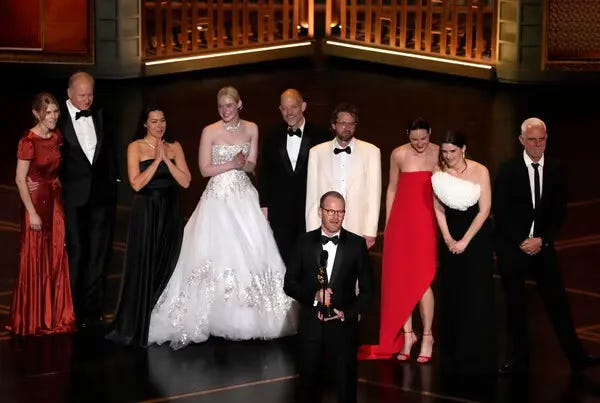
The recent Oscar win for Sentimental Value is a breakthrough moment for Norwegian film. But it also raises a bigger question - one that goes beyond a single film:
Are we actually building a cultural industry, or are we sustaining a cultural ecosystem?
This piece is an attempt to answer that question - unsentimentally.
When Politics Becomes an Industry Model
It’s easy to forget how fundamentally different politics and business really are.
Politics is about distribution, fairness, and long-term societal balance. Business is about risk, return, and selection.
Both are necessary. The problem arises when we try to use the logic of one system to run the other.
In Norway’s cultural sector, that’s exactly what we’ve done.
We’ve placed capital allocation largely in the hands of public institutions and consultants who, regardless of their competence, carry no financial risk in the outcomes of their decisions.
And when there is no risk, results inevitably become secondary.
The Equality Model - Applied Too Broadly
Norwegian cultural policy is deeply rooted in the idea that as many people as possible should have access to creative expression.
That is a value worth protecting, no question.
But when the same logic is applied to professional cultural industries, a tension emerges that we rarely acknowledge.
Because systems designed for broad participation are not necessarily suited to building globally competitive companies.
In fact, they often aren’t.
Film, TV, gaming, and music are not just cultural expressions. They are global markets defined by extreme competition - where a few succeed at scale, and many do not.
That requires a different kind of selection.
The Absence of “Skin in the Game”
One of the least discussed aspects of Norway’s cultural model is the absence of real economic risk.
Those making funding decisions do not bear the consequences of those decisions.
Those who do carry risk - creators, producers, companies—have limited influence over how capital is allocated.
This is not about individuals. It’s about incentives.
And incentives shape outcomes.
What If We Thought Differently?
Norway holds a unique position through its sovereign wealth fund.
What if a small portion of its annual returns were allocated to an independent, commercially driven investment platform for cultural industries?
Not as subsidies. As investments.
This investment platform’s mandate would be simple: build profitable companies and valuable intellectual property portfolios.
From Projects to Companies
Today, we largely finance individual projects.
But projects don’t build industries. Companies do.
By investing directly in production companies with proven execution capability, we could enable them to develop projects, compete for talent, and build long-term value.
Ownership creates accountability.
Culture’s Most Undervalued Asset Class
Globally, we’ve seen a massive influx of capital into intellectual property - music catalogs, film libraries, and other rights-based assets.
These are not sentimental investments. They are predictable, long-term revenue streams.
When global investors are moving aggressively into this space, it’s striking that Norway - with all its financial capacity - is largely absent.
This is not cultural policy. This is business. And it’s bad business to not invest in the business of culture.
Time Limits and Consequences
Another weakness in the current model is the lack of consequence.
In an investment-driven system, capital would be time-bound and tied to performance.
Companies that succeed scale. Those that don’t make room for others.
That’s not harsh. It’s how industries evolve.
A Question of Ambition
At its core, this is about ambition.
Do we want Norwegian culture to remain primarily a publicly funded ecosystem of production?
Or do we also want to build a true cultural industry - one that competes globally, on its own terms?
These goals are not mutually exclusive. But they require different tools.
A Moment Worth Using
From a distance, Norway looks like a country with everything it needs: talent, capital, stability, and global credibility.
And yet, when it comes to building cultural industries that scale internationally, we continue to underperform.
That’s not a cultural problem. It’s a structural one.
If we want Norwegian film, music, gaming, and storytelling to compete globally, not just occasionally break through, we need to rethink how capital flows into culture.
Not as support. As investment.
Because in the end, the question isn’t whether Norway can produce great artists.
It’s whether we’re willing to build the systems that allow them to win.
If you’ve made it this far, you already know this isn’t a passive read. Reels & Riffs is built for people who care about where culture is headed - and who’s shaping it. Subscribe to stay informed, and if you can, upgrade to a paid subscription to support this publication.
Feel free to leave a comment below and share your thoughts on this topic.